


There is a particular kind of quiet worry that arrives when your period doesn’t. Maybe it’s three days late and you find yourself doing mental math in the shower. Maybe it showed up two weeks early, again, and you’re tired of being caught off guard. Maybe your cycles have started behaving like a moody houseguest — long one month, short the next, heavy, then barely there. If any of this sounds familiar, take a breath. You are not broken, you are not alone, and you are almost certainly more normal than you think.
Irregular periods are one of the most common reasons women of all ages reach out to a doctor, search the internet at 11 p.m., or text a friend a slightly panicked “is this normal?” And yet, despite how common cycle changes are, most of us were never taught what a healthy cycle actually looks like, what can throw it off, or — crucially — when a change is worth a second look. We were handed a pamphlet in school that said “28 days,” and then sent out into a world where almost nobody’s body runs on a tidy 28-day loop.
This guide is here to fill in those gaps. We’ll walk through what genuinely counts as normal versus irregular, the surprisingly long list of things that can nudge your cycle off course, how irregularity connects to fertility and ovulation, and the red flags that mean it’s time to see a professional. We’ll also talk about the single most empowering thing you can do for yourself in the middle of all this uncertainty — tracking — and how modern tools, including the privacy-first vyvecare ecosystem and the Vyve app, make that easier than it has ever been.
A quick, important note before we begin: this article is general educational information, not medical advice. It can help you ask better questions and understand your body more deeply, but it can’t replace a conversation with a clinician who knows your history. Think of this as the friend who’s done the reading — not a substitute for your doctor.
A woman looking thoughtfully at a calendar
First, What Actually Counts as a “Normal” Period?
Before you can decide whether your cycle is irregular, you need a fair definition of regular — and this is where most of us were quietly set up to worry. The famous “28-day cycle” is an average, not a rule. Real bodies vary enormously, and a cycle can be perfectly healthy while looking nothing like that textbook number.
Cycle length: the big picture
Your menstrual cycle is counted from the first day of one period (day one, the first day of real bleeding) to the day before your next period starts. Most modern clinical guidance considers a cycle length anywhere from about 21 to 35 days to be within the normal range for adults. That’s a two-week spread, which surprises a lot of people. A friend with a 24-day cycle and a friend with a 34-day cycle can both be completely healthy.
What matters more than the exact number is consistency for you. If your cycles reliably land between, say, 27 and 30 days, that’s your normal. If they’re reliably 33 to 35 days, that’s also a normal — your normal. The body likes patterns, and your personal pattern is the baseline against which “irregular” should be measured.
Period length and flow
A typical period lasts somewhere between two and seven days. Flow naturally changes across those days — often heavier at the start and tapering toward the end. “Normal” flow is genuinely hard to define because it’s so individual, but a useful rule of thumb is that you shouldn’t be soaking through a pad or tampon every hour for several hours in a row, and your period shouldn’t be so heavy that it disrupts your daily life, leaves you exhausted, or has you passing large clots regularly. Color can range from bright red to brown (older blood), and a bit of variation month to month is ordinary.
Spotting between periods
Light spotting can happen and isn’t always a cause for alarm — some people spot a little around ovulation, mid-cycle, due to a small hormonal dip. Others notice spotting in the first months on a new birth control method. But spotting that’s new, frequent, heavy, or happens after sex deserves attention, especially if it keeps recurring. We’ll come back to red flags later.
So what is an irregular period?
In broad terms, your cycle might be considered irregular if:
- The length between periods keeps changing significantly month to month (for example, 24 days, then 40, then 29).
- Your cycles are consistently shorter than 21 days or longer than 35 days.
- You skip periods entirely (without pregnancy explaining it).
- Your flow swings dramatically from very light to very heavy without a clear reason.
- You have frequent spotting between periods.
One more piece of fairness here: a single weird month is not “irregular.” Bodies have off months. Stress, a cold, a big trip, a poor stretch of sleep — any of these can shift one cycle. Irregularity, in the meaningful sense, is a pattern of unpredictability, not one surprising entry on the calendar. That distinction matters enormously, and it’s exactly the kind of thing that becomes obvious only when you can see several months of data side by side.
The four phases your cycle moves through
It helps to remember that your “period” is just one visible part of a much larger, mostly invisible monthly process. Understanding the four phases makes the whole conversation about irregularity far less mysterious, because it shows you where things can go off course.
The menstrual phase is the bleeding itself — the shedding of the uterine lining when pregnancy hasn’t occurred. This is the part you can see, which is why it gets all the attention, but it’s really the end of the previous cycle as much as the start of a new one.
The follicular phase begins on the first day of your period and runs until ovulation. During this stretch, hormones prompt several follicles in your ovaries to mature, and estrogen rises steadily. Many people feel more energetic, clear-headed, and upbeat as estrogen climbs. Crucially, this is the phase whose length is most variable from person to person and month to month. When people have long or unpredictable cycles, it’s very often the follicular phase doing the stretching — the body simply taking longer to get to ovulation.
Ovulation is the brief, pivotal event when a mature egg is released. It’s typically accompanied by a small surge of hormones, a slight rise in basal body temperature afterward, and often a change in cervical mucus to a clearer, stretchier consistency. Ovulation is the hinge the whole cycle turns on, and when it’s delayed, erratic, or absent, irregularity is the natural result.
The luteal phase follows ovulation and lasts until your next period. After releasing the egg, the now-empty follicle produces progesterone, which prepares the uterine lining. This phase tends to be more consistent in length — often around twelve to fourteen days — which is why, when a cycle runs long, the extra days are usually added before ovulation rather than after it.
Why does this matter for understanding irregularity? Because it reframes the question. Instead of “why is my whole cycle unpredictable,” you can ask the more precise question: “is my ovulation happening late, erratically, or not at all?” That’s a question tracking can actually help answer — and it’s the question a doctor will be circling toward, too.
The Many Reasons a Cycle Goes Off Script
Here’s the reassuring truth: most causes of irregular periods are common, manageable, and often temporary. Your cycle is downstream of your whole body — your stress levels, your sleep, your thyroid, your nutrition, your life stage. When something shifts upstream, your period is often the first messenger to tell you about it. Let’s walk through the usual suspects.
Stress and cortisol
If there were a single most underrated cause of cycle chaos, stress would be a strong contender. When you’re under sustained pressure — work deadlines, grief, financial strain, a relationship crisis — your body pumps out cortisol, the primary stress hormone. Cortisol talks directly to the part of your brain (the hypothalamus) that orchestrates your menstrual cycle.
When the hypothalamus senses chronic stress, it can dial down the hormonal signals that trigger ovulation. The result might be a late period, a skipped period, or a cycle where you don’t ovulate at all. This is your body making a sensible (if frustrating) decision: in times of perceived threat, reproduction gets deprioritized. The good news is that this kind of stress-related irregularity often resolves once the pressure eases and your nervous system gets a chance to settle.
Thyroid issues
Your thyroid — that small, butterfly-shaped gland in your neck — has an outsized influence on your cycle. Both an underactive thyroid (hypothyroidism) and an overactive one (hyperthyroidism) can throw periods off. Hypothyroidism often makes periods heavier and more frequent; hyperthyroidism can make them lighter and less frequent. Thyroid problems are more common in women than men, frequently under-diagnosed, and very treatable once identified — which is one reason a doctor will often order a simple thyroid blood test when you bring up cycle changes.
Polycystic ovary syndrome (PCOS)
PCOS is one of the most common hormonal conditions in people who menstruate, and irregular periods are often its loudest symptom. With PCOS, the ovaries can produce higher-than-typical levels of androgens (sometimes called “male” hormones, though everyone has them), which can interfere with regular ovulation. The result is often infrequent, unpredictable, or absent periods, sometimes alongside other signs like acne, excess hair growth, weight changes, or difficulty conceiving.
PCOS is a spectrum, and it looks different from person to person. It’s also very manageable with the right support — lifestyle approaches, and sometimes medication — but it does need a proper diagnosis. If your periods are persistently irregular and you have other symptoms, this is worth raising with a clinician. Detailed cycle records make that conversation far more productive, because patterns of infrequent or absent ovulation are exactly what a doctor is looking for.
Weight changes — in either direction
Body fat isn’t inert; it’s hormonally active and plays a role in estrogen production. Significant weight loss or gain, or being at a very low or very high body weight, can disrupt the delicate hormonal balance that drives your cycle. Rapid weight loss in particular can cause periods to become irregular or stop, because the body interprets it as a signal that resources are scarce. This isn’t about any “ideal” number on a scale — it’s about big, fast changes and the extremes on either end.
Over-exercise and energy availability
Movement is wonderful for your cycle in moderate amounts. But intense, high-volume exercise — especially when it’s not matched by enough food — can suppress the reproductive hormones and lead to missed periods. This is well documented in endurance athletes and is sometimes part of a broader pattern clinicians call relative energy deficiency. The underlying issue is often that the body simply isn’t getting enough fuel to run both a demanding training load and a menstrual cycle, so it economizes. If you’ve ramped up training and your period has gone quiet, that’s a meaningful signal worth honoring rather than ignoring.
Perimenopause
If you’re in your late 30s, 40s, or early 50s and your once-predictable cycle has started doing unpredictable things, perimenopause is a likely explanation. This is the transitional stretch — which can last several years — leading up to menopause, when estrogen and progesterone levels fluctuate and gradually decline. Cycles in perimenopause famously become irregular: shorter, then longer, heavier, then lighter, with skipped months in between. It’s a natural life stage, not a malfunction, though the symptoms that come with it can absolutely be worth discussing with a doctor.
Coming off hormonal birth control
If you’ve recently stopped the pill, removed an IUD, or come off another hormonal method, your cycle may take some time to find its rhythm again. Hormonal contraception works by overriding your natural cycle, so when you stop, your body has to resume running the show on its own. For some people that happens quickly; for others it takes a few months. It’s also worth knowing that the “periods” you had on the pill were technically withdrawal bleeds, not true menstrual cycles — so your real, natural pattern may look different from what you got used to.
Breastfeeding and the postpartum period
After having a baby, periods can stay away for a while, and breastfeeding is a big reason. The hormone prolactin, which supports milk production, also suppresses ovulation. As nursing patterns change and your baby starts feeding less frequently, cycles typically return — but they may be irregular at first as your body recalibrates. The whole postpartum hormonal landscape is in flux, so a stretch of unpredictability here is expected.
Illness, medications, and one-off disruptions
A bad bout of flu, a surgery, a new medication, a course of certain treatments — any significant physical stressor can ripple into your cycle. Some medications list menstrual changes among their side effects. Even a single intense illness can delay or alter one period. Usually this kind of disruption is temporary and resolves as you recover.
Travel, jet lag, and circadian disruption
Your cycle is tied to your body clock more than most people realize. Cross several time zones, work a run of night shifts, or go through a stretch of badly broken sleep, and your circadian rhythm gets scrambled — which can nudge your hormones and shift your period. Frequent travelers and shift workers often notice their cycles wobble. This is usually benign and settles once your routine stabilizes, but it’s a great example of how something seemingly unrelated to your reproductive system can still move it.
Other hormonal conditions and uterine factors
Beyond the most common culprits, a handful of other conditions can show up as irregular bleeding, and they’re worth naming so you know they exist. High prolactin levels (the milk-production hormone) outside of breastfeeding can suppress ovulation and cause missed periods. Uterine fibroids and polyps — non-cancerous growths in or on the uterus — can cause heavy or irregular bleeding and spotting between periods. Endometriosis and adenomyosis, conditions involving the uterine lining tissue, are more associated with pain and heavy bleeding than with timing irregularity, but they can complicate the overall picture. Pelvic infections can cause abnormal bleeding too. None of these is a reason to panic — most are common and treatable — but they’re part of why a doctor evaluates persistent irregular bleeding rather than assuming it’s “just hormones.” You don’t need to diagnose yourself; you just need to know that recurring abnormal bleeding has explanations a clinician can investigate.
Diabetes, blood sugar, and metabolic health
Your metabolic health and your cycle are more connected than they appear. Insulin resistance — the body’s reduced responsiveness to insulin — is closely linked with PCOS and can contribute to irregular ovulation. Poorly managed blood sugar, whether from diabetes or significant dietary swings, can ripple into hormonal balance and cycle timing. This is part of why the lifestyle foundations we’ll discuss later (steady nutrition, movement, sleep) genuinely help: they support stable blood sugar, which in turn supports a more stable cycle. It’s all one connected system, which is both the challenge and the opportunity.
A friendly doctor reassuring a young woman patient

Occasional Irregularity vs. a Pattern That Needs Attention
Here’s the framing that helps most: think of your cycle as a long-running conversation, not a single sentence. One odd month is a typo. A repeated, consistent change is the body actually trying to tell you something.
When occasional irregularity is normal
It’s genuinely normal to have:
- An off month after a stressful event, illness, or major travel.
- Some variability in your teens and early 20s, when cycles are still maturing.
- Variability in the months after starting or stopping hormonal birth control.
- Natural shifts as you move through different life stages.
In these situations, a single irregular cycle followed by a return to your normal pattern is usually nothing to worry about. Bodies aren’t machines, and a little month-to-month wobble is part of being human.
When a pattern deserves a closer look
It’s worth booking a conversation with a clinician if:
- Your cycles are consistently shorter than 21 days or longer than 35 days.
- You regularly skip three or more periods in a row (and aren’t pregnant).
- Your periods become very heavy, very painful, or much longer than usual.
- You bleed or spot between periods repeatedly, or after sex.
- Your cycle suddenly changes dramatically and stays changed.
- Irregularity comes with other symptoms — significant weight change, excess hair growth, severe acne, hair loss, fatigue, or difficulty conceiving.
The theme here is persistence and pattern. One surprising month is a footnote. A repeated, sustained change is a chapter — and chapters are worth reading carefully, ideally with a professional. This is precisely where having real, recorded data transforms a vague “I think things have been weird lately” into a clear, evidence-backed account your doctor can actually work with.
How Irregular Cycles Affect Fertility and Ovulation Timing
For anyone trying to conceive — or anyone trying to avoid it — irregular cycles raise an obvious and important question: when, exactly, am I ovulating? And the honest answer with irregular cycles is: it’s harder to know, which is exactly why understanding the mechanics matters.
The ovulation connection
In a typical cycle, ovulation — the release of an egg — happens roughly in the middle, and there’s a fertile window of about six days leading up to and including ovulation (because sperm can survive for several days). The egg itself is only viable for about a day. So timing matters, and predictability is a gift when you’re trying to conceive.
With irregular cycles, ovulation can happen earlier, later, or at a wildly different point each month — or, in some cycles, not at all. A cycle where no egg is released is called an anovulatory cycle. You can have what looks like a period (some bleeding) without having ovulated, which is one reason irregular cycles can be confusing: bleeding doesn’t always mean you ovulated.
Why this matters for conception
If you’re trying to get pregnant, irregular ovulation makes it harder to time intercourse for the fertile window, and frequent anovulatory cycles reduce the number of opportunities to conceive across a year. This doesn’t mean conception is impossible — many people with irregular cycles do conceive — but it does mean understanding your individual patterns becomes far more valuable. Tracking signs of ovulation (changes in cervical mucus, basal body temperature, cycle length over time) helps you and your doctor figure out whether and when you’re ovulating.
Why this matters even if you’re not trying to conceive
Even if pregnancy isn’t on your radar, ovulation is a vital sign of overall health. Regular ovulation reflects a well-functioning hormonal system, and the hormones produced around ovulation (like progesterone) support everything from bone health to mood to sleep. Persistently anovulatory cycles can be a clue that something hormonal needs attention. In other words, your ovulation status is useful information regardless of your family-planning intentions.
The catch is that ovulation is invisible without clues — and irregular cycles muddy the clues. This is where consistent tracking moves from “nice to have” to genuinely powerful, because the patterns only emerge when you can look across many months at once.
Why Tracking Is the Single Most Useful Thing You Can Do
If you take one practical action from this entire guide, let it be this: start tracking your cycle. Not because tracking changes your hormones directly, but because it transforms uncertainty into understanding — and understanding is where your power lives.
Tracking turns confusion into a pattern
When your cycles feel chaotic, it’s because you’re experiencing them one month at a time, with no memory of the wider picture. “Was last month short or long? When did I last spot? Have I actually skipped, or does it just feel that way?” Our memories are terrible at this. Tracking externalizes it. After a few months of recording, what felt like random chaos often reveals itself to be a pattern — and even an irregular pattern is still information. Sometimes people discover their “irregular” cycles are actually consistently long, which is a completely different (and reassuring) story than true unpredictability.
Tracking gives your doctor real data
Picture two versions of the same appointment. In the first, you say, “I think my periods have been kind of irregular lately, maybe?” In the second, you open an app and show six months of cycle lengths, flow notes, symptoms, and skipped months laid out clearly. The second conversation is dramatically more productive. Doctors make better decisions with real data, and you become an active partner in your own care rather than a guesser. For a stretched-thin clinician, a clean record can be the difference between “let’s wait and see” and “let’s investigate this properly.”
Tracking helps catch anovulatory cycles and subtle shifts
When you log symptoms alongside dates — cervical mucus changes, basal body temperature, energy, mood, sleep — patterns of ovulation (or its absence) start to surface. You may notice cycles where the usual ovulation signs simply don’t appear. Catching a run of anovulatory cycles early means you can raise it with a professional sooner rather than discovering it after months of confusion. Tracking is, in effect, an early-warning system for your hormonal health.
Tracking is reassuring
There’s a less clinical benefit that matters just as much: peace of mind. Knowing what your body tends to do — even if what it does is be a little unpredictable — is calming. It replaces the 11 p.m. spiral with a quiet “oh, this happened in March too, and it sorted itself out.” That sense of being informed about your own body is genuinely good for your mental health.
What, exactly, should you be tracking?
If you’re new to this, the prospect of “tracking” can feel vague. Here’s a concrete, beginner-friendly list of what’s worth recording. You don’t need to log all of it — start with the first few and add more as it becomes habit.
- Period start and end dates. This is the non-negotiable foundation. From these two points, an app can calculate your cycle length and period length automatically.
- Flow intensity day by day — light, medium, heavy — plus any unusually large clots. Over time this reveals whether your bleeding is genuinely heavy or just feels that way in the moment.
- Spotting outside your period, including when it happens relative to your cycle.
- Cervical mucus changes. As you approach ovulation, mucus often becomes clearer, stretchier, and more slippery (sometimes described as egg-white-like). Logging this is one of the most useful natural ovulation signs.
- Basal body temperature, if you want to go deeper. Taken first thing in the morning before getting up, it typically rises slightly after ovulation, confirming that ovulation occurred.
- Mood and energy. Anxiety, irritability, low mood, motivation, focus — these often track with cycle phases and can flag patterns like premenstrual symptoms.
- Physical symptoms. Cramps, headaches, breast tenderness, bloating, skin changes, digestive shifts, sleep quality.
- Lifestyle context. Big stress events, travel, illness, changes in exercise or diet — so that when a cycle looks odd, you have the context to explain it.
The beauty of a well-designed app is that logging most of this takes seconds a day, and the software does the pattern-finding for you. You’re not doing math; you’re just leaving breadcrumbs your future self — and your doctor — can follow.
How to start tracking without it becoming a chore
The biggest reason people abandon tracking is that they make it too elaborate too fast, miss a few days, feel guilty, and quit. Don’t do that. Start absurdly small: log your period start date and your flow, and nothing else, for the first month. Once that’s automatic, add one symptom you care about — maybe mood, maybe cramps. The goal is a habit you’ll keep for months, because months is where the value lives. A perfect week of tracking tells you almost nothing; an imperfect six months tells you a great deal. Forgive the missed days, and just keep going.
A phone showing a cycle tracking app
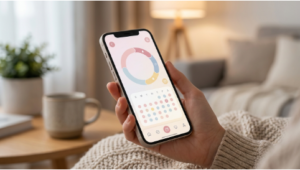
Where the Vyve App Fits In
Tracking only works if it’s easy enough to actually keep up with, and smart enough to make sense of messy, real-world cycles. This is exactly the problem the Vyve app was built to solve — and it’s worth a closer look if irregular cycles are part of your life.
Most period apps were designed around the fiction of the tidy 28-day cycle. They predict your next period by drawing a straight line from the average and calling it a day. For someone with regular cycles, that’s fine. For someone with irregular cycles, it’s frustratingly wrong — the app confidently predicts a period that doesn’t arrive, or misses one that does. The whole point of the vyvecare approach is to do better than that lazy average.
AI predictions that adapt to your irregular cycles
Vyve’s predictions are powered by AI that learns your individual patterns rather than forcing you into a template. Instead of assuming 28 days, it studies your history — the variability, the long months, the short ones — and adapts its forecasts as it learns more about you. For irregular cyclers, this is the difference between an app that gaslights you with wrong dates and one that actually reflects the body you live in. The more you log, the more the predictions tune themselves to your reality. You can find the Period Tracker App on the App Store, and it’s designed from the ground up with adaptive, irregular-friendly cycles in mind.
The AI Cycle Coach
One of the standout features is the AI Cycle Coach — think of it as a knowledgeable, non-judgmental companion you can actually ask questions. Wondering why your cycle was short this month, what a particular cluster of symptoms might mean, or what’s worth mentioning to your doctor? The Cycle Coach is there to help you interpret your own data in plain language. It doesn’t replace a clinician, but it does help you understand what you’re seeing and arrive at your appointment better informed. For anyone who’s ever closed a confusing tracking screen feeling more anxious than before, having a coach to talk it through is a real shift.
Symptom and mood tracking
Cycles aren’t just about bleeding dates — they ripple through your energy, mood, skin, sleep, digestion, and more. Vyve’s symptom and mood tracking lets you log all of it, building a rich picture over time. This is where the magic of pattern recognition happens: you might discover that your low-mood days cluster at a particular point, or that certain physical symptoms reliably precede your period. For irregular cycles especially, symptom logging often reveals the ovulation and hormonal cues that raw dates alone can’t show. It’s also exactly the kind of holistic record that makes a doctor’s appointment far more useful.
Cycle-synced Food and Nutrition
Here’s a feature that sets Vyve apart from the basic-calendar crowd: cycle-synced Food and Nutrition guidance. Your nutritional needs and how your body uses energy can shift across the phases of your cycle, and Vyve offers food and nutrition support designed to move with those phases rather than ignore them. For people working on regulating their cycles through lifestyle — which, as we’ll see, is often a meaningful lever — having nutrition guidance built into the same app you’re already using for tracking is genuinely practical.
Privacy-first by design
Few categories of personal data are as sensitive as reproductive health, and Vyve treats it that way. The app is built with a privacy-first philosophy, designed so that your most intimate information is handled with the care it deserves. In an era when many people are rightly cautious about where their cycle data goes, this matters. The whole vyvecare ethos is that understanding your body shouldn’t require surrendering your privacy. You can explore the full approach at vyvecare and download the Period Tracker App when you’re ready to start building your own picture.
If you want to go deeper on cycle education and reviews of what to look for in a tracker, the team behind the best period tracker resources also publishes plain-language guides on period and cycle health that pair well with hands-on tracking. Between a thoughtful app and good education, you’re far better equipped than the pamphlet ever made you.
Lifestyle Steps That Can Help Regulate Your Cycle
While some causes of irregularity need medical treatment, many everyday cycles respond meaningfully to lifestyle. None of this is a magic fix, and none of it replaces care for an underlying condition — but these are the general, well-supported foundations that help your hormonal system do its best work. Think of them as creating the conditions in which your cycle can settle.
Nutrition: feed the system
Your cycle runs on energy and nutrients, full stop. The single most important nutritional principle for cycle health is eating enough — under-fueling is one of the most common, overlooked causes of irregularity. Beyond adequacy, a varied diet built around whole foods supports hormonal balance: plenty of vegetables and fruit, quality proteins, healthy fats (your body literally makes hormones from fats), and complex carbohydrates for steady energy. Iron matters too, especially if your periods are heavy, since blood loss depletes iron stores. Cycle-synced nutrition support, like the Food and Nutrition feature in Vyve, can make eating with your cycle feel less abstract and more doable. The headline, though, is simple: don’t starve the system you’re trying to regulate.
Sleep: the underrated regulator
Sleep is when your body does much of its hormonal housekeeping, and poor or irregular sleep is directly tied to cycle disruption. Aim for consistent, sufficient sleep — going to bed and waking at roughly the same times, protecting seven-plus hours where you can, and treating sleep as non-negotiable rather than the first thing you sacrifice. If shift work or travel scrambles your schedule, even small efforts to anchor your routine (consistent light exposure in the morning, a wind-down ritual at night) can help your circadian rhythm — and by extension your cycle — stay steadier.
Stress management: lower the cortisol
Since chronic stress is such a common cycle disruptor, managing it is genuinely therapeutic, not just nice-to-have. This looks different for everyone: breathwork, meditation, time outdoors, therapy, boundaries around work, creative outlets, connection with people you love. The goal isn’t a stress-free life (that doesn’t exist) but a nervous system that gets regular chances to come down from high alert. Many women find that combining practical tracking with reflective, calming practices helps them feel more grounded during uncertain stretches — some pair their cycle awareness with mindfulness, journaling, or reflective tools like the AI tarot and astrology companion Raka Ai, using it as a gentle prompt for self-reflection rather than as a forecast. Whatever the method, the point is the same: a calmer nervous system is a more regular cycle’s best friend.
Gentle, consistent movement
Movement helps regulate hormones, manage stress, support healthy weight, and improve sleep — a quadruple win for your cycle. The key word is balance. Moderate, regular movement (walking, strength training, yoga, swimming, cycling) supports cycle health, while excessive, under-fueled, high-intensity training can suppress it. If your cycle has gone quiet alongside a heavy training load, the most helpful move may be to scale back intensity and eat more, not to push harder. Listen to what your body is telling you — and tracking, again, makes that feedback legible over time.
Be patient and consistent
Lifestyle changes work on cycle time, not internet time. Because a full cycle takes weeks, you generally need to give changes a few months before judging their effect — which is, conveniently, exactly the window over which good tracking reveals whether things are improving. Consistency beats intensity here, every single time.
A note on supplements and “cycle-balancing” trends
The internet is awash in products promising to “balance your hormones” and fix irregular periods overnight. A grounded word here: some nutrients genuinely matter for cycle health — iron if you’re depleted from heavy bleeding, vitamin D, omega-3s, and adequate overall nutrition — but supplements are not a substitute for addressing an underlying cause, and “hormone-balancing” marketing is often more confident than the evidence behind it. Before starting any supplement, especially if you’re on other medications or have a health condition, it’s worth a quick check with a pharmacist or doctor. The unglamorous fundamentals — eating enough, sleeping well, managing stress, moving moderately — outperform almost any pill you can buy, and they don’t come with a marketing budget riding on them. If a product promises to “regulate” your cycle in days, treat that claim with healthy skepticism and let your tracked data, not the packaging, tell you what’s actually working.
The mind-body loop
It’s worth naming something that often gets lost in clinical discussions: worry about your cycle can itself affect your cycle. Anxiety raises stress hormones, which can further disrupt ovulation, which creates more irregularity, which fuels more anxiety. It’s a genuine loop, and breaking it anywhere helps. This is one of the quiet reasons tracking is so valuable — by replacing uncertainty with information, it lowers the background hum of worry, which is good for both your mind and, indirectly, your hormones. Tending your mental health isn’t separate from tending your cycle; it’s part of the same work.
A calm reassured woman at home

Red-Flag Symptoms: When to See a Doctor
We’ve touched on this throughout, but it deserves its own clear section, because knowing when to seek help is as important as knowing how to support yourself at home. Again — general information, not medical advice — but these are the signs that genuinely warrant a professional conversation, and sooner rather than later.
Make an appointment if you experience:
- Periods that suddenly stop for three or more cycles when you’re not pregnant.
- Cycles consistently shorter than 21 days or longer than 35 days.
- Very heavy bleeding — soaking through a pad or tampon every hour for several hours, passing large clots, or bleeding that disrupts your life.
- Periods lasting longer than seven days regularly.
- Bleeding or spotting between periods, especially if it’s recurrent.
- Bleeding after sex.
- Bleeding after menopause (after you’ve gone a full year without a period) — this always warrants prompt evaluation.
- Severe pain that isn’t managed by usual measures or that’s getting worse over time.
- Irregularity plus other symptoms: unexplained weight change, excess hair growth, severe acne, hair loss, persistent fatigue, hot flashes, or difficulty conceiving after a reasonable period of trying.
- Any change that worries you and won’t settle. You don’t need to justify seeking reassurance.
A doctor can run simple tests — bloodwork for thyroid and other hormones, perhaps an ultrasound — to get to the bottom of what’s going on. Many causes of irregular periods are very treatable once identified, and getting answers is empowering, not alarming. The worst outcome is usually the not knowing, and that’s the one thing within your control to fix. And remember: you’ll walk into that appointment far more prepared if you’ve been tracking, because you’ll bring real data instead of vague impressions. Resources from the best period tracker guides can also help you frame the right questions to ask.
What to expect at the appointment
Knowing what’s likely to happen can take the edge off booking that visit. A clinician will usually start by asking about your history — when your periods began, what your normal pattern looks like, when the changes started, your other symptoms, your stress levels, your medications, and whether pregnancy is possible. This is exactly where your tracked data shines, because you can answer precisely instead of guessing. From there, they may do a physical exam, order blood tests (commonly thyroid function, and sometimes other hormones depending on your symptoms), and possibly recommend a pelvic ultrasound to look at your ovaries and uterus. Depending on the findings, they might reassure you that nothing needs treatment, suggest lifestyle adjustments, prescribe something to regulate your cycle, or refer you to a specialist. None of these steps is frightening — they’re just the process of getting answers.
Questions worth bringing with you
To make the most of a short appointment, it helps to arrive with questions written down. A few worth considering: Given my pattern, what’s the most likely cause? Which tests do you recommend, and what will they tell us? Is my irregularity something that needs treatment, or something to monitor? What lifestyle changes would help most in my specific case? Are any of my symptoms a sign I should come back sooner? If I’m trying to conceive, how does this affect my approach? Writing these down ahead of time means you won’t leave the room realizing you forgot the thing you most wanted to ask — a near-universal experience when nerves and a ticking clock are involved.
Putting It All Together: A Gentle Action Plan
Let’s translate all of this into something you can actually do, starting this week.
- Start tracking today. Don’t wait for a “fresh” cycle. Log where you are now and build from here. The Period Tracker App from Vyve is designed to adapt to irregular cycles rather than fight them, so it’s a forgiving place to begin even if your data feels messy.
- Log more than dates. Record flow, symptoms, mood, sleep, and anything notable. The richer your record, the more useful the patterns — and Vyve’s symptom and mood tracking makes this quick rather than tedious.
- Lean on the tools. Use the AI Cycle Coach to make sense of what you’re seeing, and explore cycle-synced Food and Nutrition if you want to support your cycle through diet. Let the AI predictions learn your real pattern over a few months.
- Tend the foundations. Eat enough, sleep consistently, move moderately, and give your nervous system regular off-ramps from stress. These aren’t glamorous, but they’re where most everyday improvement comes from.
- Mind your mind, too. Uncertainty about your body can be quietly draining. Pair practical tracking with whatever helps you feel grounded — connection, movement, mindfulness, or reflective practices. Some women enjoy combining cycle awareness with self-reflection tools like Raka Ai, using a moment of calm reflection as a companion to the data rather than a replacement for it.
- Know your red flags. Keep the warning-sign list in mind, and don’t hesitate to see a doctor if something persists or worries you. Bring your tracked data with you — it’s one of the most useful things you can hand a clinician.
- Keep learning. Good education compounds. The plain-language guides at best period tracker and the broader vyvecare resources are there whenever you want to understand a new symptom or stage.
Frequently Asked Questions
How late does a period have to be before it’s considered “late”?
Periods are usually considered late once they’re more than about five to seven days past when you’d expect them, based on your typical cycle length. But with irregular cycles, “expected” is a moving target — which is exactly why tracking your personal range matters. If you might be pregnant, a late period is reason to take a test. If pregnancy is ruled out, an occasional late period is rarely cause for concern; a consistent pattern of unpredictability is what’s worth discussing with a doctor.
Is it normal for my cycle length to change month to month?
A little variation is completely normal — even healthy cycles aren’t identical every month, and a swing of a few days is nothing to worry about. What’s worth watching is large, consistent variability (for instance, swinging from 24 days to 40 days repeatedly) or cycles that fall consistently outside the roughly 21–35 day range. Tracking over a few months is the best way to tell the difference between ordinary variation and a meaningful pattern.
Can stress really stop my period?
Yes. Significant or chronic stress raises cortisol, which can suppress the hormonal signals that trigger ovulation, leading to late, skipped, or absent periods. This is one of the most common causes of temporary irregularity. The encouraging part is that stress-related changes often resolve once the stress eases and your nervous system has time to recover.
I just stopped birth control and my periods are irregular. Is that normal?
Very much so. Hormonal birth control overrides your natural cycle, so when you stop, your body needs time to resume running things on its own. For some people that’s quick; for others it takes a few months. Remember too that the bleeds you had on the pill weren’t true menstrual cycles, so your natural pattern may simply look different from what you were used to. If irregularity persists for several months, check in with a doctor.
Could irregular periods mean I have PCOS?
Irregular periods are one of the most common signs of PCOS, but they’re not proof of it on their own — plenty of other things cause irregularity. PCOS typically involves irregular or absent ovulation alongside other features like elevated androgen levels (which can show up as acne or excess hair growth). Only a clinician can diagnose it, usually through a combination of history, blood tests, and sometimes an ultrasound. Tracked cycle data is genuinely helpful in that process, because it documents the very pattern of infrequent ovulation a doctor is looking for.
Can I still get pregnant with irregular periods?
Yes, many people with irregular cycles conceive. Irregular ovulation can make timing trickier and may mean fewer fertile windows across a year, but it doesn’t make pregnancy impossible. Tracking ovulation signs — cervical mucus, basal body temperature, cycle patterns — helps you identify your fertile windows. If you’ve been trying for a while without success, or your cycles are very irregular, a fertility-aware doctor can help.
What is an anovulatory cycle?
It’s a cycle in which no egg is released. You can still have bleeding that looks like a period without having ovulated, which is one reason irregular cycles can be confusing — bleeding doesn’t automatically mean ovulation happened. Occasional anovulatory cycles are normal, but frequent ones can affect fertility and may signal a hormonal issue worth investigating. Detailed symptom tracking helps surface them.
Does tracking my cycle actually help if it’s irregular?
Arguably it helps more when your cycle is irregular, not less. Tracking turns a confusing, one-month-at-a-time experience into a visible pattern over time, helps you and your doctor spot issues like anovulatory cycles, and gives you real data instead of guesses. Even an irregular pattern is valuable information — and an AI-powered app like Vyve can learn your individual rhythm and adapt its predictions accordingly, rather than forcing you into a generic 28-day template.
How is the Vyve app different from a basic period calendar?
Basic calendars predict your next period by averaging past cycles, which falls apart for irregular cyclers. Vyve uses AI that learns your individual patterns and adapts as it goes, includes an AI Cycle Coach to help you interpret your data in plain language, offers symptom and mood tracking and cycle-synced Food and Nutrition guidance, and is built privacy-first. You can find it as the Period Tracker App and read more about the approach at vyvecare.
How long should I track before patterns become clear?
Because each cycle spans weeks, you generally want at least two to three months of tracking before patterns start to emerge, and three to six months gives a much clearer picture — especially with irregular cycles. The same window applies when you’re testing lifestyle changes: give them a few cycles before judging their effect. Consistency over those months is what makes the data meaningful.
Are irregular periods in your teens or early 20s normal?
Yes. In the first few years after periods begin, cycles are often irregular as the hormonal system matures, and this usually settles with time. That said, if irregularity is severe, comes with significant symptoms, or persists well beyond the early years, it’s still worth a conversation with a doctor — youth doesn’t rule out conditions like PCOS or thyroid issues.
Can losing or gaining weight really affect my period?
Yes. Body fat is hormonally active and influences estrogen, so significant or rapid weight changes — and the extremes on either end — can disrupt your cycle. Rapid weight loss in particular can cause periods to become irregular or stop. This is about big, fast changes and extremes, not about any “ideal” number on a scale. Gentle, sustainable habits tend to support cycle health far better than drastic ones.
Is heavy bleeding something I should worry about?
It depends on what’s normal for you and how heavy it is. Bleeding that soaks through a pad or tampon every hour for several hours, includes large clots, lasts longer than seven days, or leaves you exhausted is worth getting checked — both to find the cause and because heavy periods can lead to iron deficiency. Tracking your flow helps you and your doctor judge whether it’s genuinely heavy or simply varies a bit month to month.
Can travel and jet lag mess up my cycle?
Yes. Crossing time zones, night shifts, and disrupted sleep scramble your circadian rhythm, which can nudge your hormones and shift your period. This is usually temporary and settles once your routine stabilizes. Anchoring your sleep schedule and morning light exposure can help your body clock — and your cycle — recover faster.
When is irregular bleeding an emergency versus a “book an appointment” situation?
Bleeding so heavy that you’re soaking through protection every hour for several hours, feeling faint or short of breath, or bleeding after menopause should prompt prompt medical attention. Persistent irregularity, recurrent spotting between periods, or irregularity with other symptoms is a “book an appointment soon” situation rather than an emergency. When in doubt, a quick call to a clinician for guidance is always reasonable — you never need to justify seeking reassurance.
Do I need to see a doctor, or can I just track and wait?
If your irregularity is mild, recent, and clearly tied to something temporary (stress, travel, coming off birth control), tracking and giving it a few months is reasonable. But if cycles are consistently outside the normal range, you skip three or more periods, bleeding is very heavy or painful, or irregularity comes with other symptoms, see a doctor. Tracking and seeing a doctor aren’t either/or — the best approach is usually to track and bring that data to your appointment.
Can thyroid problems really cause irregular periods?
Yes, and it’s more common than many people realize. Your thyroid regulates metabolism throughout your body, including the systems involved in your cycle. An underactive thyroid often leads to heavier, more frequent periods, while an overactive one tends toward lighter, less frequent ones. Thyroid conditions are notably more common in women and are easily checked with a simple blood test. This is one reason doctors so often order thyroid testing when cycle changes come up — and one reason it’s worth mentioning any other thyroid-related symptoms you’ve noticed, like fatigue, weight changes, temperature sensitivity, or mood shifts.
Why does my period app keep predicting the wrong dates?
Most likely because it’s using a simple average and assuming your cycle is more regular than it is. Traditional apps predict your next period by averaging your past cycles, which works for regular cyclers but falls apart when your cycle length genuinely varies. The fix is an app whose predictions actually adapt to irregularity. Vyve’s AI-driven approach learns your individual patterns rather than forcing a one-size-fits-all template, so its forecasts improve as it gathers more of your data. If your current app has been confidently wrong for months, that’s a sign it’s the wrong tool for your particular cycle, not a sign that your cycle is un-trackable.
Will an irregular cycle “fix itself” over time?
Sometimes, yes — especially when the cause is temporary, like stress, travel, illness, or recently coming off birth control. In those cases, cycles often settle on their own once the trigger passes. But irregularity caused by an underlying condition (thyroid issues, PCOS, and so on) usually needs that condition addressed before things improve. This is exactly why tracking matters: it helps you distinguish “this is settling on its own” from “this isn’t improving and deserves a look.” Time alone resolves some cases and quietly masks others, and only consistent data tells you which is which.
Is it bad to have very light periods?
Not necessarily. Just as “normal” flow varies widely between people, so does what counts as light. Some people simply have light periods, and that can be perfectly healthy. What’s worth paying attention to is a change — periods that suddenly become much lighter than your norm, or become very infrequent — particularly if it comes with other symptoms or if you’re not on a hormonal method that would explain it. Context and change matter more than the absolute amount. If a shift to very light or infrequent bleeding is new and unexplained, it’s reasonable to mention to a doctor.
Can breastfeeding affect how long my periods stay away?
Yes, significantly. The hormone prolactin, which supports milk production, also suppresses ovulation, so many people don’t get their periods back for months while breastfeeding — and the timing varies a lot depending on how frequently and exclusively you’re nursing. As feeding patterns change, cycles typically return, often irregularly at first while your body recalibrates. Importantly, ovulation can resume before your first postpartum period, so it’s possible to become pregnant again before your cycle visibly returns — worth knowing if you’re not planning back-to-back pregnancies.
A Final, Reassuring Word
If you came to this article anxious about your cycle, here’s what we most want you to carry away: irregular periods are common, usually explainable, and very often manageable. Your body isn’t betraying you — it’s communicating with you. A late period, a skipped month, a stretch of unpredictability: these are messages, and messages can be understood.
The most empowering thing you can do is move from worry to information. Start paying attention. Start tracking. Notice the patterns, support your body with the steady fundamentals of good food, real sleep, gentle movement, and a calmer nervous system, and don’t hesitate to bring a professional into the conversation when something persists or concerns you. You deserve to understand your own body, and that understanding is more within reach than ever.
Modern tools make this genuinely easy. An adaptive, privacy-first companion like the Vyve Period Tracker App can learn your individual rhythm, coach you through what you’re seeing, and turn months of confusion into a clear, usable picture — the kind your doctor will thank you for. Pair it with solid education from resources like best period tracker and the broader vyvecare library, lean on whatever reflective practices help you stay grounded — for some, that’s mindfulness or a self-reflection companion like Raka Ai — and you’ll find that the quiet 11 p.m. worry slowly gives way to something far better: confidence.
Your cycle is part of your story. Learn to read it, and you take back the pen.
This article is for general educational purposes only and does not constitute medical advice. Always consult a qualified healthcare professional about your individual health and any changes in your menstrual cycle.